Live public monitoring
Codex Monitor
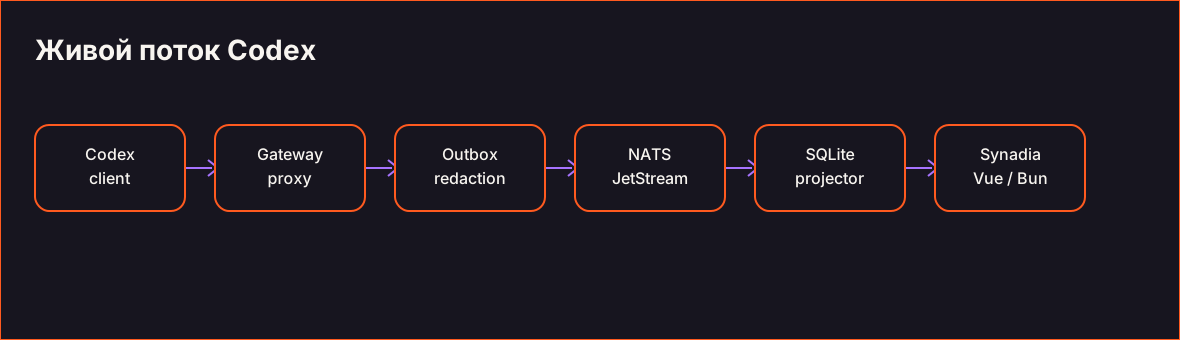
Codex Monitor displays real events copied by Codex Gateway from HTTP, SSE and WebSocket traffic. A non-blocking outbox publishes sanitized events to NATS JetStream, a projector stores the view in SQLite, and Bun/Vue exposes sessions, reasoning, tools, usage, errors and public broadcasts.
Archived screenshot of the previous version: The protected owner console shows real Codex sessions, the active request, available reasoning text, responses and proxy token usage.
01 / The task
Live stream of Codex sessions and tool activity
The goal was to observe Codex activity on a separate subdomain without affecting model requests. Monitoring must tolerate NATS outages, resume by cursor and separate owner-only sessions from explicitly published broadcasts.
Use case: The owner observes Codex work while visitors see only explicitly published read-only sessions.
Work done
- Added HTTP, SSE and WebSocket observation inside the Ruby proxy without changing the primary relay flow.
- Implemented sanitization, a bounded file outbox, a dedicated JetStream stream and a durable SQLite WAL projector.
- Extended the Vue interface with sessions, reasoning and tool timeline, traffic, usage, delivery health and comparison.
- Added manual chat titles, collapsible service context, publication preview, expiring links and immediate broadcast revocation.
02 / Implementation
What sets the implementation apart
Events come from the real proxy rather than a UI simulator. eventId and sequence make projection idempotent, the durable consumer acknowledges after persistence, and usage is counted per attempt without re-adding snapshots. Temporary links can be revoked immediately; the older YouTrack flow remains a separate subsystem.
Screenshots
Screens, forms, errorsScreenshots, diagrams and source evidence retain their original language; captions and descriptions are translated.
03 / Technology
Stack
Shares use Git application-file bytes at pinned revisions. Each file belongs to one subsystem under scripts/generate-stack-share.mjs rules; tests, assets, dependencies and generated files are excluded. Rounded to 0.1%. This describes code composition, not proficiency.
Vue 3 / TypeScript
Protected console, public broadcast, timeline and cursor-based UI recovery.
Bun
Protected and public HTTP/WebSocket APIs, preview, publication and link revocation.
NATS JetStream
CODEX_TRACE stream, retention limits, durable delivery and separate credentials.
SQLite WAL
Idempotent projection of events, attempts, usage, titles and publications.
Ruby Codex proxy
HTTP/SSE/WebSocket observation, sanitization and a non-blocking file outbox.
04 / Decisions
How the project works
- The proxy copies sanitized events into a bounded outbox; NATS downtime does not stop a Codex request.
- The JetStream consumer acknowledges an event after a transactional projection write; eventId and sequence protect history from redelivery.
- Usage is stored per attempt and revision snapshot: cached counts within input, reasoning within output, and legacy aggregates remain separate.
- The default title comes from the first user message. A manual Codex Monitor title takes precedence and does not rename the chat in Codex.
- A public link contains only the permitted history of one selected session, lasts up to seven days and stops immediately on revocation.
- The earlier YouTrack/NATS worker remains a separate path and is not mixed with passive Codex monitoring.
- The monitor and YouTrack gateway use NATS directly. The Synadia Agents SDK, discovery and generic prompt bridge were removed; job and result queues are preserved.
05 / Verification
Demo workflows
- Select a session, set a clear title and inspect the instruction, reasoning, messages and tools in chronological order.
- Open Traffic and correlate request, attempt, transport, duration and sanitized event identifiers.
- Review per-attempt usage and inspect proxy, NATS, projector, cursor and outbox state.
- Review the permitted history range, publish a temporary link, open it as a visitor and revoke it immediately.
Check results
- In the live load snapshot, event delivery p50 was 128 ms and p95 was 172 ms; model response time is excluded.
- One validation session ledger increased by 272 tokens and retained the same total after a projector restart.
- During validation the outbox was empty, NATS had no pending or ackPending messages, and no OOM event was found.
Limitations
- Codex Gateway is the sole data source; local Codex Desktop and App Server files are not read.
- Encrypted reasoning is not reconstructed, hidden system/developer instructions are not stored, and no traffic only means no new events.
- Agent hierarchy appears only with explicit proxy identifiers; the system does not start, stop or reconfigure models.
- Automatic sanitization covers known secrets, while the owner still reviews the full preview before publishing.
Technical notes
Modules, API, data model, setup and check results.
Documentation →Materials ↓